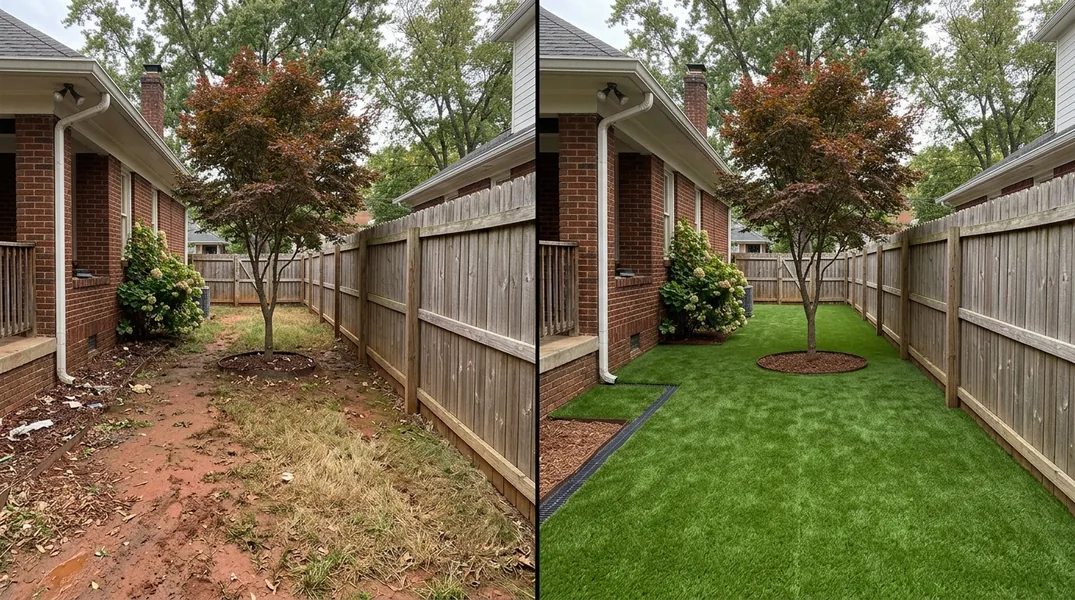
The Nashville Lawn Problem: Why Real Grass Struggles Here
If you live in Nashville, you know the struggle. Summer heat beats down on your lawn, cool-season fescue turns brown and dormant, and by mid-July your yard looks more like a straw pile than the lush green space you imagined. Then fall arrives, Bermuda grass starts to fade, and you're left wondering why maintaining a real lawn feels like a full-time job.
The truth is, Nashville's climate creates a unique challenge for traditional lawns. Our region sits in a transition zone where cool-season grasses like fescue thrive in spring and fall but struggle during our hot, humid summers. Warm-season grasses like Bermuda do better in the heat but go dormant and turn brown from November through March. Most homeowners end up with a lawn that's either stressed, discolored, or requiring constant intervention to look acceptable year-round.
Fescue Burnout: Why Cool-Season Grass Fails in Nashville Summers
Fescue is a popular choice for many Nashville homeowners because it germinates quickly and looks great in spring. However, fescue has a critical weakness in our climate: it cannot tolerate prolonged heat and humidity. When summer temperatures consistently exceed 85 degrees Fahrenheit, fescue experiences what turf professionals call 'heat stress.' The grass blades begin to thin, disease pressure increases, and the plant essentially shuts down to conserve energy. What you see is progressive browning, bare patches, and a lawn that looks tired and neglected even if you're watering regularly.
The problem gets worse if you try to keep fescue alive through summer. Over-watering to compensate for heat stress actually increases disease risk, particularly fungal issues like brown patch and dollar spot. Many Nashville homeowners find themselves in a frustrating cycle: they invest in fescue in spring, it looks beautiful for a few months, then they spend all summer trying to nurse it through the heat. By August, most fescue lawns in our area are noticeably stressed, and the damage often carries into fall.
Dormant Bermuda: The Brown Winter Problem
Bermuda grass is the opposite problem. It thrives during hot Nashville summers and stays green when fescue has given up. But Bermuda's strength is its weakness during winter. As temperatures drop in November, Bermuda enters dormancy and turns a dull tan or brown color. This dormancy lasts until late April or May, meaning your yard looks dead or dying for nearly six months out of the year. For homeowners who take pride in their landscape, a brown Bermuda lawn throughout winter is simply not acceptable.
Some Nashville homeowners try to overseed their Bermuda with cool-season rye in fall to maintain green color through winter. While this can work, it requires precise timing, extra fertilizer, and careful management. The rye competes with Bermuda in spring, and you have to manage the transition carefully to avoid damaging your base Bermuda stand. It's an added expense and labor that many homeowners either don't know about or find too complicated to execute properly. Even when done correctly, overseed rye never looks quite as lush or uniform as a true perennial turf system.
Artificial Grass vs. Real Grass: The Honest Comparison
This is where the comparison becomes clear. When you're weighing turf vs artificial grass, the decision often comes down to what matters most to you. Real grass has undeniable appeal: it's natural, it feels authentic underfoot, and there's something satisfying about maintaining a living lawn. However, real grass in Nashville comes with genuine trade-offs that many homeowners don't fully appreciate until they've struggled through a few seasons.
Artificial grass eliminates the seasonal color problem entirely. Modern synthetic turf stays green and vibrant year-round, regardless of whether it's 95 degrees in July or 35 degrees in January. There's no fescue burnout, no Bermuda dormancy, and no need for overseeding. You get consistent, attractive lawn color every single day of the year. Beyond color, artificial grass requires dramatically less maintenance: no weekly mowing, no fertilizing schedules, no disease management, and significantly less watering. For a low maintenance yard, artificial turf is genuinely transformative.
The trade-off is that artificial grass is not living turf. Some homeowners have environmental concerns about synthetic materials, and that's a valid consideration. Others prefer the feel of natural grass or the ability to say their lawn is 'real.' These are personal preferences, and they matter. However, if your priority is a beautiful, green, low-maintenance lawn that performs well in Nashville's climate, artificial grass has become a compelling alternative.
Low Maintenance Yard Benefits: Why Homeowners Are Making the Switch
The maintenance difference between real grass and artificial turf is not marginal; it's transformational. A typical real lawn in Nashville requires weekly mowing during growing season, regular fertilizer applications, pest and disease monitoring, irrigation management, and seasonal maintenance like dethatching or aeration. Over a year, this adds up to dozens of hours of work or significant spending on lawn care services. Artificial grass eliminates almost all of this burden.
With artificial turf, your maintenance routine becomes simple: occasional brushing to keep the fibers upright, rinsing to remove dust or pollen, and removing debris like leaves or branches. That's genuinely it. You don't need a mower, you don't need a fertilizer schedule, and you don't need to worry about disease pressure or insect damage. For busy Nashville homeowners, retirees who want to spend their time differently, or anyone who simply doesn't enjoy yard work, this shift is life-changing. The money you save on lawn care services, equipment maintenance, and water bills can be substantial over time.
Beyond the time and money savings, a low maintenance yard also means less stress. You're not watching your lawn decline during summer heat or worrying about winter dormancy. You're not dealing with brown patches or thin areas. Your yard simply looks good, consistently, without requiring constant attention or intervention.
Residential Artificial Grass Installation Cost in Nashville: What to Budget
Cost is always a legitimate consideration when comparing turf vs artificial grass. Residential Artificial Grass Installation requires an upfront investment that's higher than the cost of seeding or sodding a real lawn. However, the long-term financial picture is more nuanced than it first appears. Modern artificial turf typically lasts 15 to 20 years with proper care, and the maintenance savings during those years are substantial. If you're currently spending $100 to $200 per month on lawn care services, that's $1,200 to $2,400 per year. Over 15 years, that's $18,000 to $36,000 in maintenance costs alone.
The actual pricing for artificial grass installation varies based on yard size, existing soil conditions, and the specific product chosen. Most Nashville homeowners should expect installation costs to range from several thousand dollars for smaller yards to $15,000 or more for larger properties. While this is a real investment, the return comes through years of eliminated maintenance costs, reduced water bills, and the convenience factor that many homeowners find invaluable. To understand the specific cost for your property and how it compares to your long-term real lawn maintenance expenses, reaching out for a free estimate is the best approach. You can also call Nashville Turf Installation directly at (615) 913-4865 to discuss your specific situation.
Many homeowners also don't realize that artificial grass can increase property value or curb appeal, particularly if your real lawn has been struggling with the Nashville climate. A consistently green, well-maintained artificial yard often makes a stronger visual impression than a seasonal real lawn that looks brown or stressed for portions of the year.
When to Choose Real Grass vs. Artificial Turf in Nashville
So which is right for your Nashville home? The honest answer is that it depends on your priorities, budget, and lifestyle. Real grass makes sense if you genuinely enjoy yard work, prefer a natural lawn, and are willing to accept seasonal color changes and maintenance demands. It's also the right choice if you're on a tight budget and can't afford the upfront installation cost of artificial turf. Real grass is also better if you have pets that spend significant time digging or if you need a lawn that can handle heavy foot traffic in ways that some artificial products cannot.
Artificial grass makes sense if you want a consistently beautiful lawn with minimal maintenance, if you're tired of seasonal color problems, or if you value your time more than you value the 'natural' aspect of your yard. It's particularly attractive if you're in Franklin, Brentwood, or Murfreesboro and dealing with similar climate challenges. If you have a specific use case like Pet Turf & Dog Run Installation or Pool Surround Turf, artificial turf offers unique advantages that real grass simply cannot match.
The best way to make this decision is to honestly assess what matters most to you. If you'd like professional guidance specific to your property and situation, Nashville Turf Installation is ready to help. Contact us at (615) 913-4865 or request a free estimate to explore your options with no obligation.
Looking for a professional artificial grass installation company in Nashville? Nashville Turf Installation responds fast for all your artificial grass installation needs.
Get a Free Quote