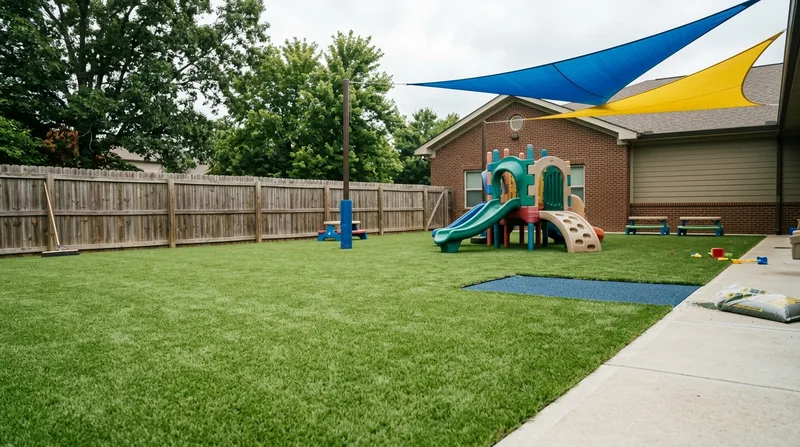




Playground & School Turf in Nashville solves a problem that real grass cannot: consistent, safe, low-maintenance play surfaces that endure heavy foot traffic and Nashville's freeze-thaw winters without thinning, bare patches, or mud. Schools and daycare facilities across Nashville, Franklin, Brentwood, and Murfreesboro face the same challenge. During the winter, natural grass sits dormant and brown; in summer, the heat and humidity thin it out; and year-round, drainage issues on the red clay and limestone base leave wet, slippery conditions after the afternoon thunderstorms that roll through Middle Tennessee. Synthetic turf for playgrounds delivers consistent color, safe drainage, and a cushioned surface that meets fall-height and impact-attenuation standards. We install playground turf that performs in the Central Basin climate, backed by written specifications for face weight, pile height, infill type, and base depth so you know exactly what you're getting.
Why Playground & School Turf Matters in Nashville Schools and Daycare Centers
Natural grass playgrounds in the Nashville area face relentless wear. Heavy traffic from hundreds of children, combined with the region's wet springs and hot, dry summers, creates bare patches, muddy zones, and uneven surfaces that pose tripping hazards. Schools and facilities must close play areas after storms while the ground dries, and winter brings dormancy that leaves brown, dead-looking turf for months. Synthetic turf eliminates these closures, provides year-round color and usability, and meets ASTM impact-attenuation standards for fall safety.
- Ensures consistent, safe play surface throughout the year, eliminating weather-related closures and seasonal dormancy.
- Meets ASTM F1292 impact-attenuation requirements for fall heights and critical fall distances on playgrounds.
- Reduces maintenance labor and costs by eliminating weekly mowing, overseeding, and drainage repairs.
- Drains rapidly after rain, preventing muddy, slippery conditions that breed injuries and liability.
- Lasts 8 to 12 years with routine cleaning, delivering a long service life for school budgets.
Playground turf is a capital investment that protects children and reduces operational burden on facilities staff.
Key info: Nashville schools in Donelson, Bellevue, and Inglewood, as well as daycare centers in Germantown and The Nations, have replaced natural grass playgrounds with synthetic turf to extend play seasons and meet safety fall-height standards. The Cumberland River valley's heavy clay soil holds water after storms, making drainage a critical factor that natural turf cannot match.
For more details on how turf handles high-traffic environments, see our commercial artificial grass installation page, which covers similar durability and drainage principles.
How We Install Playground & School Turf in Nashville
Playground turf installation begins with a site walk to assess drainage, soil compaction, and fall-height requirements. We remove the existing natural grass or sod, grade and compact the subgrade, install a perforated base layer (typically 4 to 6 inches of crushed limestone or recycled asphalt), and lay a geotextile to separate base from infill. We then install the synthetic turf, seam and edge it securely, and top-dress with infill (typically silica sand and recycled rubber or a specialized antimicrobial blend) that provides cushioning and drainage. The entire process takes 2 to 5 days depending on field size and site conditions.
- Conduct a site assessment to confirm drainage, measure fall heights, and identify utilities and underground lines before excavation.
- Remove existing grass, sod, and topsoil, then grade the subgrade to eliminate low spots and ensure uniform drainage.
- Compact the base layer (4 to 6 inches of crushed stone) to 95% Proctor density so the turf sits stable and level.
- Lay geotextile and install the turf, seaming and edging it with adhesive and fasteners to prevent lifting or movement.
- Top-dress with infill, rake to uniform depth, and water the infill to settle it and lock the fibers in place.
Each step follows ASTM standards for synthetic turf installation, and we provide written specifications naming the turf product, face weight, pile height, infill type and depth, and base specifications so the facility has a complete record.
Local example: A school playground in Franklin, Tennessee required a 3,200-square-foot turf field with a 12-inch fall height for equipment up to 9 feet tall. We removed the old, thin natural grass, installed a 5-inch compacted limestone base, laid a 60-ounce-face-weight turf with a 2-inch pile, and top-dressed with silica sand and crumb rubber. The project took 4 days and delivered a safe, durable play surface that drains in 2 to 4 hours after rain.
Learn more about our turf removal and replacement process to understand site prep in detail.
Installation Methods and Specifications for Playground Turf
| Approach | Description | Best for |
|---|---|---|
| Full Base Preparation | Remove sod, compact subgrade, install 4 to 6 inches of crushed limestone base, lay geotextile, install turf and infill to ASTM standards. | New playground fields, areas with poor drainage or uneven grade, facilities upgrading from failing natural grass. |
| Overlay Installation | Install turf directly over existing compacted base if subgrade is stable and drainage is adequate, reducing labor and cost. | Well-maintained existing fields with solid base and good drainage, minor upgrades or replacement of existing turf. |
| High-Impact Infill Systems | Use engineered infill blends (silica sand with crumb rubber or polyurethane) formulated to meet ASTM F1292 impact attenuation for specific fall heights. | Equipment-heavy playgrounds, multi-story structures, facilities with strict liability or insurance fall-height requirements. |
| Antimicrobial Infill | Blend infill with zeolite or similar antimicrobial additive to reduce odor, mold, and bacterial growth in high-moisture environments. | Schools with drainage challenges, daycare centers in humid areas, playgrounds subject to standing water or frequent irrigation. |
Playground & School Turf Cost in Nashville: What to Expect
Playground turf costs in the Nashville area typically start at $10 to $14 per square foot installed, depending on field size, existing site conditions, base preparation requirements, and infill type. A 2,000-square-foot playground field generally runs $20,000 to $28,000; a 5,000-square-foot field ranges from $50,000 to $70,000. The largest cost drivers are base preparation (removing and disposing of existing sod, grading, compacting), the turf product itself (face weight and pile height), infill type and depth, and site access for equipment and material delivery. Schools with poor drainage or uneven grades require deeper base work, which increases the overall price. Getting 2 to 3 estimates from local turf installers allows you to compare specifications, base depth, infill type, and warranty terms so you understand what each price includes.
For a detailed pricing overview and factors that affect your specific project, visit our full pricing page.
Playground & School Turf Near Me: What Nashville Facilities Should Look for When Hiring a Turf Installer
Choosing the right turf installation company for a school or daycare playground is critical because poor workmanship, inadequate base preparation, or the wrong infill type can compromise fall safety and drain your budget. Before hiring, verify that the installer carries general liability and workers' compensation insurance and can provide a certificate naming both coverages. Request a written specification that names the turf product, face weight, pile height, infill type and depth, base material and compaction density, and workmanship warranty. Check references from other schools or playgrounds in Nashville, Murfreesboro, or Franklin where they have worked, and ask to see photos of completed installations. Understand whether your school or facility requires permits from the Metro Nashville Planning Department or your county building department; some jurisdictions require site plans or impact assessments for large projects, so defer to your local building official. If your facility is part of an HOA or has architectural review requirements, confirm that synthetic turf is permitted before you sign a contract.
Ready to move forward? Contact us for a free, no-obligation estimate and we'll walk you through the process, answer your questions about fall heights and safety standards, and provide a detailed written proposal.
Key info: We are fully insured and provide written specifications for every playground project. Our estimates are free and include a site walk, drainage assessment, and a detailed proposal with all materials, labor, and timeline. Call us at (615) 913-4865 or request an estimate online; we respond within 24 hours.
Playground & School Turf in Nashville: Pricing Guide
| Service | Price | Details |
|---|---|---|
| Small playground field (1,000 to 2,000 sq ft) | Starting at $10/sq ft | Includes sod removal, base prep, turf installation, and standard silica infill for typical fall heights |
| Medium to large field (2,000 to 5,000 sq ft) | Starting at $12/sq ft | Higher face weight turf, deeper base for drainage, antimicrobial or high-impact infill, and extended warranty |
| Complex site with poor drainage or uneven grade | On estimate | Requires site assessment to determine base depth, grading work, and drainage improvements needed before accurate pricing |
| Infill upgrade or replacement | Starting at $2/sq ft | Refresh existing turf with new infill, antimicrobial treatment, or impact-attenuation blend to meet current safety standards |
| Travel and site visit | Included | No charge for estimates or site walks within Nashville and surrounding service areas |
| Estimate | Free | Free, no-obligation written proposal with specifications, timeline, and warranty details within 24 hours |
Indicative pricing, the exact cost depends on square footage, finish, and site access. Free personalized estimate within 24h at (615) 913-4865.


